Thursday, January 30, 2014

Old Enough to Fight, Old Enough to Vote: The 26th Amendment

We have needs and problems
and goals to share;
It’s a test of our purpose,
and how much we care.

The time is now!
Citizens, awake!
Battalions for the ballot!
Our future is at stake!
-Jennings Randolph, “Father of the 26th amendment”

Thursday, January 23, 2014

The Civil Rights Act of 1964


According to a public-opinion survey distributed by the Bureau of Intelligence in 1942, “the vast majority of white Americans were ‘unaware that there [was] any such thing as a Negro problem’ and were convinced that blacks were satisfied with their social and economic conditions” (Foner 880). This was very alarming to me, considering that the majority of Americans were oblivious and believed that all blacks agreed with segregation, the “separate but equal” institutions were indeed equal [picture segregation], and blacks enjoyed living in poverty while the white population had the privilege to participate in the prominent consumer culture. It could attributed to the fact that white people believed segregation “didn’t restrict [them] in any way, so it was easy to accept things the way they were” (Foner 960). This survey was taken a year after A. Philip Randolph wanted to March on Washington, calling for equal employment, an abolishment of segregation, and a national antilynching law, which did bring about Executive Order 8802, but somehow in the following year the majority of white Americans believed that black Americans were perfectly fine with their poor living, social, and economic conditions.

Thursday, January 16, 2014

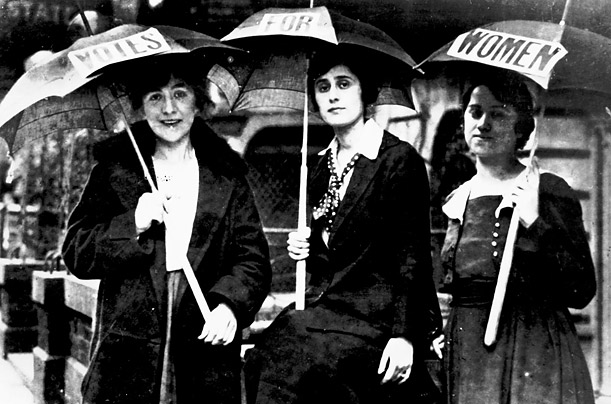
Women's Path to Ratification: The Passage of the 19th Amendment


After being treated unfairly by King George III, the colonists demanded independence from Britain, thus the creation of the Declaration of Independence. In this declaration it states “that all men are created equal”. It can be assumed that by the word “men” the author meant mankind, therefore all people are created equal. Since most assumptions prove to be wrong, this assumption will not leave anyone disappointed. It is widely known that in the “Land of the Free” during 1776 and in present time that this assumption is not true and may never be. From 1789 until 1869 only white men who were property owners were given the privilege, not the right, to vote. The passage of 15th amendment in 1870 granted African American men the right to vote. It was not until fifty years later that women were given the right to vote under the Constitution, though fourteen states prior granted women suffrage. Honestly, this is quite surprising to me. How could men, who after the Dred Scott v. Sandford Supreme Court decision were deemed as not human, but instead property, be given the right to vote before white women? How could property be given the right to vote before women? Now just let that sink in for a minute. Though Black men were no longer slaves, the United States government did have not to give them the right to vote (Even though most were denied the privilege to exercise it). What does this say about the way men viewed women? 

Sunday, January 5, 2014

The Dawes Severalty Act of 1887

In the Declaration of Independence, Thomas Jefferson writes, “He has excited domestic insurrections amongst us, and has endeavored to bring on the inhabitants of our frontiers, the merciless Indian savages, whose known rule of warfare, is undistinguished destruction of all ages, sexes and conditions.


Though it is arguable, I believe that Native Americans are the most discriminated group in United States history. They have been forced into slavery, robbed of their land because of the “divine right” granted to the United States to expand its borders, encountered racism, and experienced ruthless violence in the land that they once called home, just to name a few. Most the racism experienced by Native Americans have been erased from public high school textbooks and have vanished from the majority of the population’s minds. Children are taught in school about the peaceful dinner shared between Plymouth colonists and Wampanoag Native Americans, but never about the Ash Hollow Massacre.