
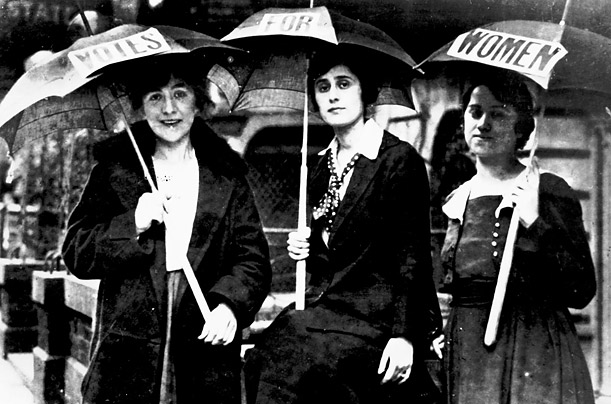
After being treated unfairly by King George III, the
colonists demanded independence from Britain, thus the creation of the
Declaration of Independence. In this declaration it states “that all men are
created equal”. It can be assumed that by the word “men” the author meant
mankind, therefore all people are created equal. Since most assumptions prove
to be wrong, this assumption will not leave anyone disappointed. It is widely
known that in the “Land of the Free” during 1776 and in present time that this assumption
is not true and may never be. From 1789 until 1869 only white men who were
property owners were given the privilege, not the right, to vote. The passage
of 15th amendment in 1870 granted African American men the right to vote. It
was not until fifty years later that women were given the right to vote under
the Constitution, though fourteen states prior granted women suffrage.
Honestly, this is quite surprising to me. How
could men, who after the Dred Scott v. Sandford Supreme Court decision were deemed as not human, but instead
property, be given the right to vote
before white women? How could property be given the right to vote before
women? Now just let that sink in for a minute. Though Black men were no longer
slaves, the United States government did have not to give them the right to
vote (Even though most were denied the privilege to exercise it). What does this say about the way
men viewed women?
During the 1800s, women, or the “weaker” sex, were treated
as second-class
citizens. Women could not own property, sign a contract, and keep the wages
they earned, among many other restrictions. They were also strongly discouraged
to further their education or gain the proper knowledge to pursue a
professional career. But, they were taught how to cook, sew, clean, and look
after children. Their sole place was in the home, given very little respect
outside of it. This is evident when Lucretia Mott, American abolitionist, was
denied her seat at anti-slavery convention in London, though she was an
official delegate, due to her sex. Mott consulted with Elizabeth Cady Stanton
and pushed to organize and hold the first women’s rights convention after the
incident occurred. The Seneca Falls Convention (1848) held in Seneca Falls, New
York, was attended by about 300 people.
 |
| Elizabeth Cady Stanton & Susan B. Anthony |
Modeled after the Declaration of
Independence, the Declaration of Sentiments states “that all men and women are created equal”, clarifying
any confusion that may have been caused by the previous assumption. I love how
Stanton modeled it after the same document that Thomas Jefferson, a man,
drafted after the unjust treatment of King George III. While reading the
Declaration of Independence, one will read it in the colonists’ perspective.
While reading the Declaration of Sentiments, one will read it in a woman’s
perspective. Since the second paragraph of the Declaration of Sentiments is
very closely worded to the Declaration of Independence, the sentence “Whenever
any form of government becomes destructive of these ends, it is the right of
those who suffer from it to refuse allegiance to it, and to insist upon the
institution of a new government, laying its foundation on such principles, and
organizing its powers in such form, as to them shall seem most likely to effect
their safety and happiness” becomes very powerful. If the colonists had the
right to “alter or to abolish [the government] and institute a new Government…
organizing its powers in such form, as to them shall seem most likely to effect
their Safety and Happiness” because
they believed it was destructive, why can’t women? The Declaration was signed by sixty-eight women and thirty-two men,
including Fredrick Douglass, marking the nationally recognized start of the
Women’s Suffrage Movement. It would not be until 50 years later that women were
deemed worthy enough to be granted this privilege under the Constitution.

During the war “some 22,000 served as clerical workers and nurses with American forces in Europe. Many believed wartime service would earn them equal rights at home” (Forner 741). They played a
 |
| 19th amendment [soure] |
Tennessee who “tip[ped] the scale for woman suffrage”, raising the number of ratifications to 35 – the two-thirds majority needed. Interestingly, Tennessee was close to
James M. Henslin, sociology professor at Southern Illinois
University, claims he has inside
information of how to earn an extra
$1,465 a month, or $700,000 in a lifetime. The only thing someone has to do
is be born male. Although both sexes
advance in their careers at about the same rate, since men are given higher
starting salaries than women, this “testosterone bonus” never allows women to
be equal to men in their paid salary (Henslin 293). Sadly, the pay gap is “so
great that U.S. women who work full time average only 72 percent of what men
are paid” (Henslin 293).
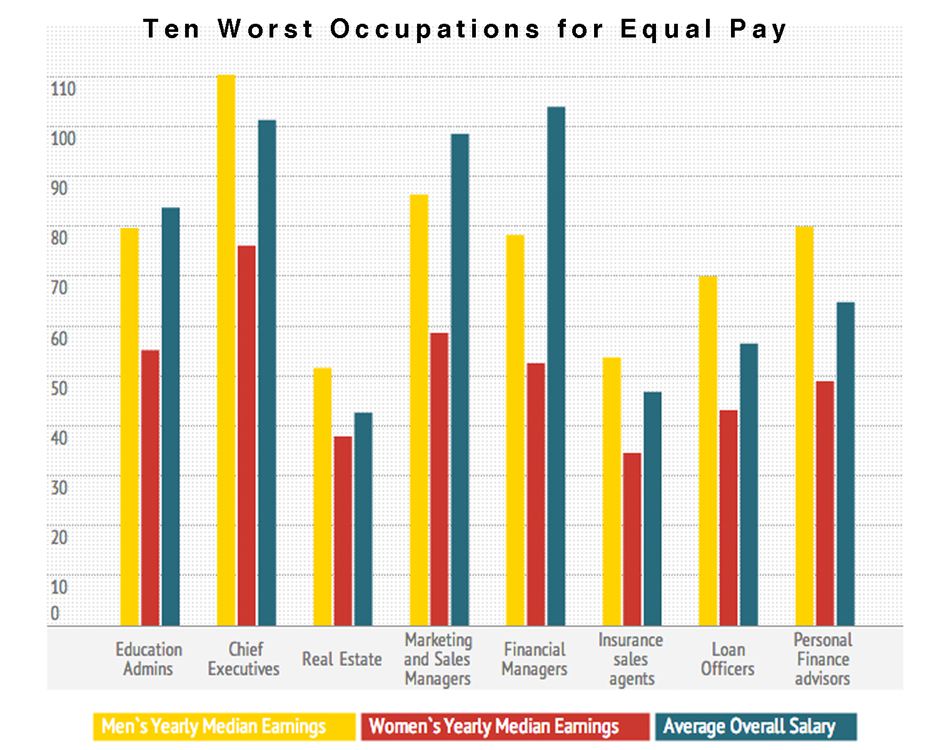 |
| Example of gender pay gap [source] |
According to Henslin, people have a greater chance of
becoming a CEO if their name is “John, Robert, James, William, or Charles…
Edward, Lawrence, and Richard” (294). However, names such as “Amber, Katherine,
Leticia, and Maria draw a severe penalty” (Henslin 294). Only twelve women are
heads of Fortune 500 companies. For example, on paper Carleton Fiorina, former
head of Fortune 500 company, appears to be male, but actually “his” first name
is Cara. Knowing the discrimination and cutthroat competition women face in the business world, she “dropped this
feminine name to go by her masculine middle name” (Henslin 294). This leads to
another barrier called the glass ceiling, an invisible blockade in place that
prevents women from advancing in their careers. The main cause is stereotypes, one being that
women are only seen as being supportive and lacking leadership capability,
therefore are confined to human resources or public relations. Another reason
is that women lack mentors, successful executives that “teach them the ropes”.
The strides women have made in order to be granted full
American citizenship, the right to vote, have been tremendous. Although they
have come a long way, the country still has a longer way to go to ensure that
all men and women are equal, including equality in the workplace.
Works Cited/References
"Elizabeth Cady Stanton." National Parks Service. National Parks Service, 16 Dec. 2013. Web. 14 Jan. 2014.
Foner, Eric. Give Me Liberty!: An American History. New York: W.W. Norton &, 2014. Print.
Henslin, James M. "Social Class in the United States." Essentials of Sociology: A Down-To-
Earth Approach, Tenth
Edition. Boston: Pearson,
2013. 228-36. Print.
Kim, Tae H. "Seattle General Strike: Where Women Worked During World War I."Seattle General Strike: Where Women Worked During World War I. University of Washington, n.d. Web. 15 Jan. 2014.
"Modern History Sourcebook: The Declaration of Sentiments, Seneca Falls Conference, 1848." Internet History Sourcebooks. Fordham University, n.d. Web. 14 Jan. 2014.
"Rights for Women." Rights for Women. National Women's History Museum, n.d. Web. 16 Jan. 2014.
"Signers of the Declaration of Sentiments." National Parks Service. National Parks Service, 15 Jan. 2014. Web. 17 Jan. 2014.
"Woman Suffrage before 1920." The Gilder Lehrman Institute of American History. Gilder Lehrman Institute of American History, n.d. Web. 17 Jan. 2014.

No comments:
Post a Comment