

According to a public-opinion survey distributed by the Bureau of Intelligence in 1942, “the vast majority of white Americans were ‘unaware that there [was] any such thing as a Negro problem’ and were convinced that blacks were satisfied with their social and economic conditions” (Foner 880). This was very alarming to me, considering that the majority of Americans were oblivious and believed that all blacks agreed with segregation, the “separate but equal” institutions were indeed equal [picture segregation], and blacks enjoyed living in poverty while the white population had the privilege to participate in the prominent consumer culture. It could attributed to the fact that white people believed segregation “didn’t restrict [them] in any way, so it was easy to accept things the way they were” (Foner 960). This survey was taken a year after A. Philip Randolph wanted to March on Washington, calling for equal employment, an abolishment of segregation, and a national antilynching law, which did bring about Executive Order 8802, but somehow in the following year the majority of white Americans believed that black Americans were perfectly fine with their poor living, social, and economic conditions.
During World War II the
modern civil rights movement began. The quote by Alice Paul, the National
Woman’s Party leader, “How could the country fight for democracy abroad, while
denying it to women at home?,” applies to every minority during the second
world war. How could Japanese Americans be draft and expected to fight for the
democracy of others, yet they were stripped of their rights guaranteed by the
fourteenth amendment by those who swore to protect those rights? Why would
black Americans go risk their lives to ensure a free world when at home they
were imprisoned? These questions were so “fragile” that American delegate at
the conference that established the United Nations (an organization designed to
ensure the “free world” stays free) “opposed any statement affirming human
rights out of fear that it would lead to an international investigation of ‘the
Negro question in this country” (Foner 910).
The double-v campaign, victory overseas and victory at home by ending
segregation, become driving force behind the protests to come. The first great
victory was the threat of a March on Washington, which resulted in the banning
of discrimination in defense jobs and the creation of the Fair Employment
Practices Commission to ensure that the laws were enforced (FDR was obligated
to pass it since “the prospect of thousands of angry blacks descending on
Washington… ‘scared the government half to death’”). Though the commission
lacked any real enforcement power, Executive Order 8802, was “hailed… as a new
Emancipation Proclamation” by the black press. It was the “first federal agency
since Reconstruction to campaign for equal opportunity for black Americans, the
FEPC played an important role in obtaining jobs for black workers in industrial
plants and shipyard…. By 1944, more than 1 million blacks, 300,000 of them
women, held manufacturing jobs” (Foner 881). I love the quote “My sister always
said that Hitler was the one that got us out of the while folks’ kitchen”
(Foner 881). It is very powerful because Randolph proclaimed racial
discrimination as “pro-Hitler”, yet Hitler (WWII) was the reason behind a great
expansion in their rights. This prominent event set the stage for the rest of
the events that would take place years later that would lead the passage of the
Civil Rights Act of 1964, Voting Rights Act, and the 24th amendment.
The next big stride taken was Brown v. Board of Education of Topeka,
Kansas, where the national government (schools in Orange County, California
where already desegregated) deemed that separate but equal did not apply to
public schools. Resisting, many southern schools frantically tried to resist
integration. Many people are familiar with the Little Rock 9, but are unaware
that they were not the first to integrate. The Clinton 12 (1956) in Clinton,
Tennessee were the pioneers. My great aunt, Alvah McSwain, was one the twelve.
Next, the Montgomery Bus Boycott that took place in response to Rosa Parks giving up her seat on a public bus resulted in the Supreme Court ruling that segregation on public transportation is unconstitutional.
Another protest that occurred
were sit-ins in Woolworth’s, a diner that did not allow black people to sit at
lunch counters, after encountering violence and abuse, the five month sit-in resulted
in the desegregation of their lunch counter. Following their example, Students Nonviolent
Coordinating Committee (SNCC) organized sit-ins. Congress of Racial Equality
(CORE) organized Freedom Rides to go from Washington D.C. to New Orleans. While
riding on interstate buses, in Alabama the bus’ tires were slashed, protesters
were almost killed by a firebomb, and were badly beaten with bats and chains.
Their perseverance was rewarded when the Interstate Commerce Commission ordered
the buses and terminals desegregated (partly because the violence was aired on
television).
 |
| The Clinton 12 |
Next, the Montgomery Bus Boycott that took place in response to Rosa Parks giving up her seat on a public bus resulted in the Supreme Court ruling that segregation on public transportation is unconstitutional.
 |
| Sit-in at Woolworth's lunch counter |
 |
| Children’s Crusade |
The turning point, in my opinion, was the Children’s March, or
Children’s Crusade in May 1963. Since Birmingham had the reputation of being
the most segregated city in America, earning its nickname “Bombingham”, MLK
believed that if they could change Birmingham, they could change the rest of
the south. The only way to “break”
Birmingham was to fill the jails and in order to do this they would need
volunteers to, well, go to jail. The only people that volunteered were
children. MLK organized this while in
jail after being arrested by Police Chief Eugene "Bull" Connor for
demonstrating without a permit with the help of his “secret weapon” James Bevel.
On “D-Day” children of all ages left school at 11:00 am with the goal of
getting arrested. At the end of day one, 973 children were arrested. By day two
Police Chief Eugene "Bull" Connor, the same person who had MLK
arrested, ordered the release of attack dogs and high powered fire hoses on a
group of children. At the end of the day 1,922 children were arrested. Day
three would result in the arrest of 4,163 children. The event made headlines,
headlines that would make their way to President Kennedy. After seeing what had
happened to these children, Kennedy felt disgusted and called Birmingham a
disgrace. A month later, calling for the passage of a bill that ended racial
discrimination, Kennedy said “We preach freedom around the world,… but are we
to say to the world, and much more importantly, to each other, that this is a
land of the free except for Negroes?” (Foner 980).
Several months after,
Kennedy was assassinated, leaving it up to his Vice President Lyndon B. Johnson
to pass the Civil Rights Act of 1964. After an 80 day filibuster in Senate
conducted by southern senators and the inclusion of women’s rights in hopes
that it would not get passed, the bill in July 1964. During his term has
President he also managed to pass the Voting Rights Act of 1965 and the 24th
amendment, outlawing the poll tax in federal elections after the efforts of
those who participated in Freedom Summer and MLK’s march from Selma to
Montgomery. The marches encountered extreme violence, such as the use of whips
and tear gas, giving it its name Bloody Sunday. Interestingly, the 24th
amendment was not adopted by Mississippi until 2013.
Video on Mississippi's adoption of the 24th amendment
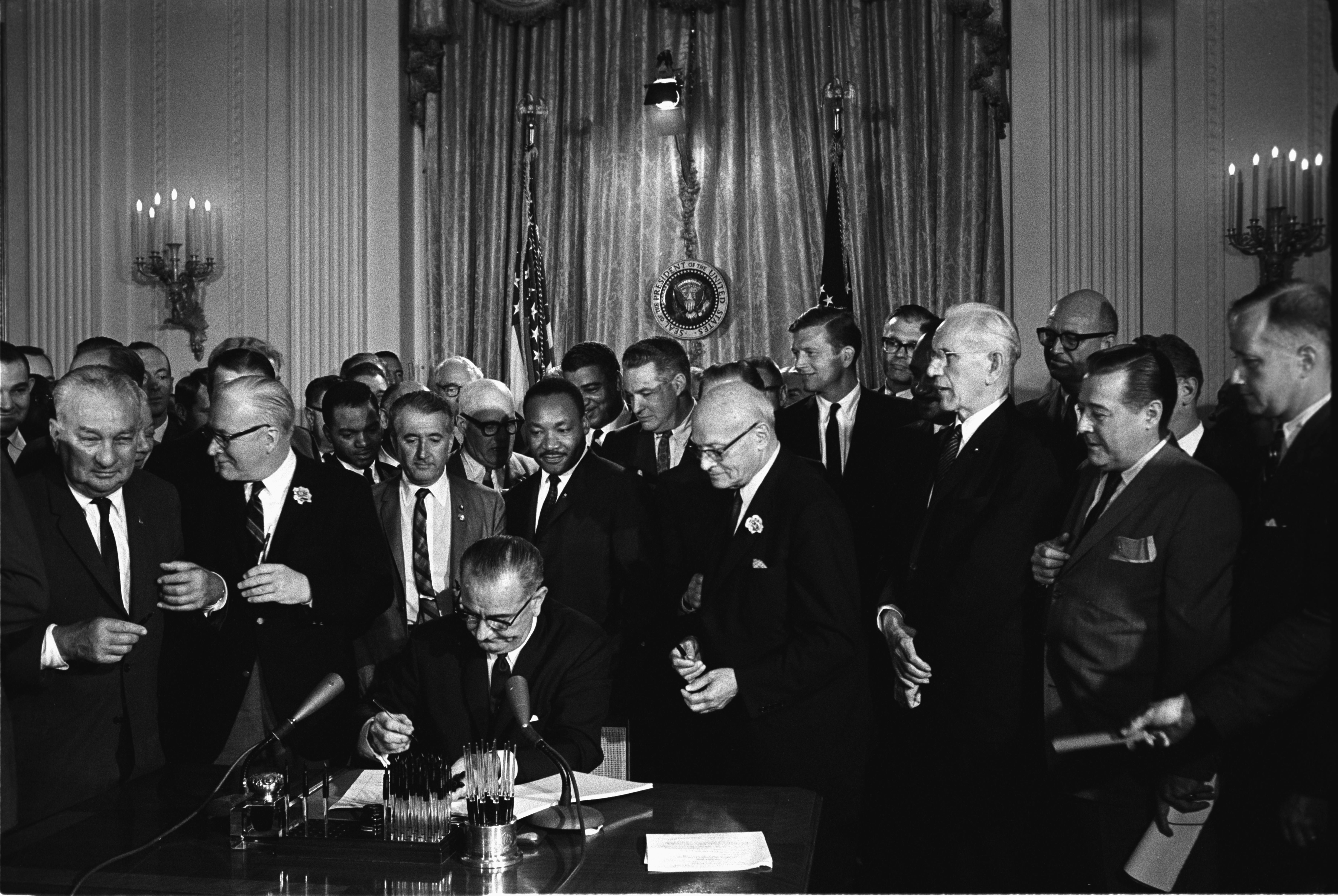 |
| President Johnson signing the Civil Rights Act |
Other than the Civil
Rights legislation passed during his term, President Lyndon B. Johnson declared
a war on poverty; this was the main focus of his idea of the Great Society,
making it the first thing he declared he’d do the night of his inauguration. Sadly,
instead of being remembered for all the good he had done for the people of his
country, he is sourly remembered for the disaster of the Vietnam War. Although
his programs that still exist today have given people great support, he failed
to eradicate poverty. In 1950, half of the nation’s black families live in
poverty. In 2012, the median household income for blacks was $33,321 while the
median of all the races was $51,017 (U.S. Census Bureau).

In 2011, fourteen of sixteen of the states with the highest poverty, 14.4% to 21.2%, were in the south where blacks make up most the population (Henslin 231). This could be attributed to the fact that African Americans have the highest high school dropout rate among all the other racial groups. If Johnson believed “The man who is hungry, who cannot find work or educate his children, who is bowed by want, that man is not fully free,” does this mean that even after all the great victories made during the 1960s Civil Rights Movement, we are still not free?
In 2011, fourteen of sixteen of the states with the highest poverty, 14.4% to 21.2%, were in the south where blacks make up most the population (Henslin 231). This could be attributed to the fact that African Americans have the highest high school dropout rate among all the other racial groups. If Johnson believed “The man who is hungry, who cannot find work or educate his children, who is bowed by want, that man is not fully free,” does this mean that even after all the great victories made during the 1960s Civil Rights Movement, we are still not free?
Just to add in my two
cents about my generation in regard to the civil rights movement… It truly
angers me how all people of color, not just black people, take for granted what
sacrifices people in the past have done in order to ensure and secure their
freedom. Many people were severely beaten, hurt, thrown in jail, and even murder
all in the effort to grant freedom for themselves, others, and the later
generations of their people. When people say they do not want to vote or take
part in politics, it just… makes me disappointed how we are taking this luxury
for granted that one hundred years ago only a minority had. Their unwillingness
to participate in politics and letting their voice be heard, will forever keep
them imprisoned due to them allowing others, senators and house of rep members,
to speak for them and not having the power to vote on what they believe will benefit them.
Works Cited
Foner, Eric. Give Me Liberty!: An American History. New York: W.W. Norton &, 2014. Print.
Joiner, Lottie L. "How the Children of Birmingham Changed the Civil-Rights Movement." The Daily Beast. Newsweek/Daily Beast, n.d. Web. 22 Jan. 2014.
Works Cited
Foner, Eric. Give Me Liberty!: An American History. New York: W.W. Norton &, 2014. Print.
Hensl Henslin, James M. "Social Class in the United States." Essentials of Sociology: A Down-To-
Earth Approach, Tenth Edition. Boston: Pearson, 2013. 228-36. Print.
"Income, Poverty and Health Insurance in the United States: 2012 - Tables & Figures."United States Census Bureau. United States Census Bureau, n.d. Web. 21 Jan. 2014.Joiner, Lottie L. "How the Children of Birmingham Changed the Civil-Rights Movement." The Daily Beast. Newsweek/Daily Beast, n.d. Web. 22 Jan. 2014.

No comments:
Post a Comment