

We have needs and problems
and goals to share;
It’s a test of our purpose,
and how much we care.
The time is now!
Citizens, awake!
Battalions for the ballot!
Our future is at stake!
-Jennings Randolph, “Father of the 26th
amendment”
After World War II America emerged as the world’s greatest power. Since the country was the symbol of freedom and the prime example of prosperity, Americans felt it was their duty to impose their values on people in other countries and secure a free world, although there were minorities here that were not “free”. Joseph Stalin, leader of the Soviet Union, held these very same aspirations. Unfortunately, America and the Soviet Union had conflicting values. Although President Franklin Delano Roosevelt hoped to maintain on friendly terms with the Soviet Union after World War II, the conflicting ideals of the world’s greatest powers were so prominent that their once harmonious alliance began to deteriorate (Foner 898). This led to the Cold War (roughly 1947–1991).
Pursing his
aspirations, Stalin installed procommunist governments in Romania, Poland, and
Bulgaria, “a step they claimed was no different from American domination of
Latin America or Britain’s determination to maintain its own empire,” which I agree with 100% (Foner 898).
 But America wanting to preserve freedom and
democracy believed that the Soviet Union was restricting free elections in
Poland after Stalin had promised to allow free elections (after, Hitler you’d
think the Allies would have been more cautious). George Kennan, American
diplomat, told the Truman administration that Soviets would continue to pursue
expansion and only the United States, with all its glory, had the power to stop
them. Upon receiving this information the U.S. vowed “‘to support free peoples
who are resisting attempted subjugation…by outside pressures’” and stop the expansion
of communism; the policy became known as containment.
But America wanting to preserve freedom and
democracy believed that the Soviet Union was restricting free elections in
Poland after Stalin had promised to allow free elections (after, Hitler you’d
think the Allies would have been more cautious). George Kennan, American
diplomat, told the Truman administration that Soviets would continue to pursue
expansion and only the United States, with all its glory, had the power to stop
them. Upon receiving this information the U.S. vowed “‘to support free peoples
who are resisting attempted subjugation…by outside pressures’” and stop the expansion
of communism; the policy became known as containment.

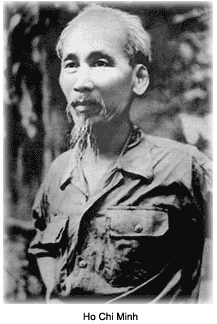
When Japan surrenders
after WWII, Vietnamese communist Ho Chi Minh declares his country’s
independence from France, proclaiming it the independent Democratic Republic of
Vietnam (very ironic since he was communist). In order to combat this, the
French claimed South Vietnam and started negotiations with the communists in the
north. Since they failed to compromise, the French invaded Haiphong, a northern
Vietnamese city starting the Indochina War. China supported the communists in
the north, while America supported the French and anticommunist forces in the
south.
 The communist were victorious. The following peace negotiations divided
Vietnam along the 17th parallel. Now, you would think that Americans
would have taken this as a warning that maybe they could not defeat the
northern Vietnamese, considering that they would turn to China once again for
help. But of course, since Presidents Kennedy and Johnson “fear[ed] that the
public would not forgive them for ‘losing’ Vietnam… foreign policy advisers saw
it as a test of whether the United States could, through “counterinsurgency” –
intervention – to counter internal uprisings in noncommunist countries – halt
the spread of Third World revolutions” (Foner 996). With the domino theory in
place, the government believed that if Vietnam fell to Communism, the rest of
the Asia would. This ideal prompted President Dwight Eisenhower pledge to help
the southern Vietnamese resist communism, a pledge that later presidents would
uphold. Kennedy sent almost 9,000 troops by 1961 after the National Liberation
Front, an anti-Diem organization in southern Vietnam, formed because he feared
the group was secretly working for the northern Vietnamese.
The communist were victorious. The following peace negotiations divided
Vietnam along the 17th parallel. Now, you would think that Americans
would have taken this as a warning that maybe they could not defeat the
northern Vietnamese, considering that they would turn to China once again for
help. But of course, since Presidents Kennedy and Johnson “fear[ed] that the
public would not forgive them for ‘losing’ Vietnam… foreign policy advisers saw
it as a test of whether the United States could, through “counterinsurgency” –
intervention – to counter internal uprisings in noncommunist countries – halt
the spread of Third World revolutions” (Foner 996). With the domino theory in
place, the government believed that if Vietnam fell to Communism, the rest of
the Asia would. This ideal prompted President Dwight Eisenhower pledge to help
the southern Vietnamese resist communism, a pledge that later presidents would
uphold. Kennedy sent almost 9,000 troops by 1961 after the National Liberation
Front, an anti-Diem organization in southern Vietnam, formed because he feared
the group was secretly working for the northern Vietnamese.
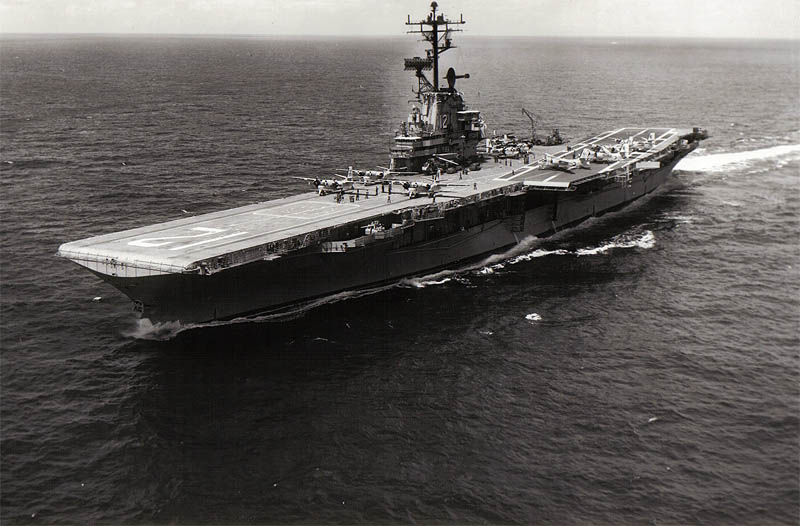 |
| The ship was "attack" in the Gulf of Tonkin |
After President
Franklin Roosevelt lowered the draft age to eighteen during World War II, young
people started questioning why they were required to go fight in armed
conflicts, but were denied the right to vote once they came back home. Jennings
Randolph, House of Representative Member of West Virginia, proposed lowering
the voting eleven times to Congress since the beginning of World War II. With the average age of soldiers being nineteen and the age groups that
suffered the highest causality rates were younger than twenty-one during the
Vietnam War, this dream would soon be fulfilled. “Old enough to fight, old
enough to vote” soon became the slogan used to lower the voting age. Roosevelt’s
successor, President Eisenhower, endorsed lowering because he believed "For
years our citizens between the ages of 18 and 21 have, in time of peril, been
summoned to fight for America. They should participate in the political process
that produces this fateful summons." After countless protests and the
Supreme Court’s decision of Oregon v. Mitchell, which could only allow the
federal voting age to be lowered in federal elections, the 26th
amendment was passed and ratified in 1971 with the hopes that states would too
pass laws to lower the voting ages in local elections.

Works Cited
"The 26th Amendment." History. A&E Television Networks, n.d. Web. 28 Jan. 2014.
"American Vietnam War Casualty Statistics." Vietnam War Casualty Statistics by Race, Sex, Religion,
Ginsberg, Benjamin. We the People: An Introduction to American Politics. New York: W.W. Norton &, 2013. Print.
"Pentagon Papers." History. A&E Television Networks, n.d. Web. 28 Jan. 2014.
"Vietnam War." History. A&E Television Networks, n.d. Web. 28 Jan. 2014.
"American Vietnam War Casualty Statistics." Vietnam War Casualty Statistics by Race, Sex, Religion,
Etc... MilitaryFactory.com, n.d. Web. 29 Jan. 2014.
Brudney, Kent M., and Mark E. Weber. Critical Thinking and American Government: Exercises and
Applications. Upper Saddle River, NJ: Pearson Education, 2012. Print.
Foner, Eric. Give Me Liberty!: An American History. New York: W.W. Norton &, 2014. Print.
"Pentagon Papers." History. A&E Television Networks, n.d. Web. 28 Jan. 2014.
"Vietnam War." History. A&E Television Networks, n.d. Web. 28 Jan. 2014.
"Vietnam War Statistics." Vietnam War Statistics. Mobile Riverine Force Assosication, n.d. Web. 29 Jan. 2014.

No comments:
Post a Comment